Average Reviews:

(More customer reviews)Are you looking to buy Science & Christianity: Four Views (Spectrum Multiview Book Series Spectrum Multiview Book Serie)? Here is the right place to find the great deals. we can offer discounts of up to 90% on Science & Christianity: Four Views (Spectrum Multiview Book Series Spectrum Multiview Book Serie). Check out the link below:
>> Click Here to See Compare Prices and Get the Best Offers
Science & Christianity: Four Views (Spectrum Multiview Book Series Spectrum Multiview Book Serie) ReviewScience & Christianity: Four Views is a well-conceived attempt to cover the spectrum of Christian thought concerning the proper interaction of theology and science as realms of knowledge. These interacting viewpoint books are a great idea but they are difficult to pull-off because at least one viewpoint usually suffers. In this book, Creationism in particular is not well represented. Since this view is a historical cornerstone in the discussion, the overall book suffers as a result.Frair and Patterson represent the Creationist viewpoint (young and old-earth views are essentially combined in this book). Their opening position statement, as expected, emphasizes the priority of an inerrant Scripture as the authority in human knowledge though they also encourage vigorous scientific inquiry and believe the two ultimately converge into one reality. But, their interactions with other viewpoints throughout the book tend to miss the point by avoiding any contrast/conflict. This avoidance hurts the value of the book and depth of their presentation.
Pond represents what is called the Independence view, which is often ignored in these discussions. Independence asserts that theology and science are two completely different areas of knowledge with no appreciable overlap in describing reality. If there is a question about the actual physical history of earth, it is resolved solely by science. Likewise, if there is a question of human spirituality it is resolved solely in the area of religion (Christianity for Pond). Pond says she considers scripture one more facet of information, which is to be considered along with church tradition (Episcopal in her case), and human reason depending upon the subject at hand. In the case of physical earth history, she sees no role for the Bible. She does not accept the notion that the scripture is inerrant and asks for a definition of the term (FYI Feinberg provides a great one in "Inerrancy" edited by Geisler). In place of inerrancy Ponds promotes the NOMA principle popularized by Stephen Jay Gould. Pond is eloquent for her position and interacts with other viewpoints in a consistent manner that provides some color to what is generally a bland book. Aside from the color she adds to the discussion, I find her view of scripture and science (along with NOMA) to be an elaborate cop-out that gives total precedence to science at every point in the discussion carrying any significance for discovering physical reality. Pond (and NOMA) seem to overlook the turbulent nature of scientific theories throughout history while discounting the possibility that the Bible has a divine author capable of giving a general but accurate description of physical reality that science is yet to fully discover.
The Qualified Agreement viewpoint is covered by Meyer and basically says that we should accept a highly interactive view of both scripture and science on a case-by-case basis where there are no hard and fast rules as to which will take precedence beforehand. After tracing the history of earlier intelligent design efforts by Paley and others, Meyer provides an onslaught of physical evidence from various fields of science. This chapter has so many well-known examples of design that the overall method (inference to the best explanation) does not receive the attention it deserves. Meyer is consistent throughout the book making most of his arguments from contemporary scientific evidence suggesting design, rather than from scripture. Meyer footnotes his evidence well and provides a veritable who's who of intelligent design authors such as Dembski, Behe, Ross and Denton.
Van Till provides the Partnership view, which says that science and Christian theology can go hand in hand without conflict. This view emphasizes a possible harmony between the two fields of knowledge and seeks to explain it with what Van Till calls the Robust Formation Economy (RFE). He prefers RFE to theistic evolution, which is more often used as a category for his viewpoint. The RFE basically says God created the universe as an amazing evolutionary machine that is capable of unfolding in the way modern evolutionary sciences say it does with no further intervention from God. Van Till feels this view ascribes more glory to God than the interventionist views held by Creationists or Qualified Agreement camps (Independence would seem to agree more with Van Till though it has no identifiable position as to interaction). Van Till's position is open to the critique (attempted but not adequately made in this book) that he is just playing games with words. Renaming deism to RFE doesn't really help things very much. His position counters scripture in a number of areas that indicate God is actively involved in the daily workings of nature, not just the macro architect from billions of years ago. Partnership ends up being a cop-out theory like Independence, it's just dressed up with fancier words and ideas, but not strong arguments based upon theological and scientific data.
This is a mediocre book that had the potential to be excellent but did not achieve that goal. There actually aren't that many intermediate books available in the area of philosophy of science and Christianity, but this is one. If you just want one book in this area choose Three Views on Creation and Evolution by Moreland and Reynolds; it is somewhat better than this book.Science & Christianity: Four Views (Spectrum Multiview Book Series Spectrum Multiview Book Serie) OverviewScience and Christianity. Are they partners or opponents?Christians have long debated the relationship of science to faith. With the rise of Darwinism, however, the issue took on new significance. Darwinism appeared to undermine the authority of the Bible and the credibility of Christianity by freeing science of the need for a Creator. Rethinking the relationship between science and Christianity quickly became a priority.
How does a faithful Christian respond to the pronouncements of contemporary science?
Is science a help or a hindrance to belief?
Are science and the Bible in conflict?
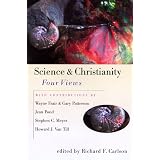
At the beginning of the twenty-first century, Christians continue to wonder whether faith and science are partners or opponents. In this book six Christian scholars sort through the issues as they present four different views on the relationship of science and Christianity. These include Wayne Frair and Gary D. Patterson for "creationism," Jean Pond for "independence," Stephen C. Meyer for "qualified agreement" and Howard J. Van Till for "partnership." Each contributor responds to the other scholars, noting points of agreement and disagreement. Editor Richard F. Carlson offers an introduction to this contemporary debate as well as a postscript to help us evaluate the strengths and weaknesses of each view.
Want to learn more information about Science & Christianity: Four Views (Spectrum Multiview Book Series Spectrum Multiview Book Serie)?
>> Click Here to See All Customer Reviews & Ratings Now

0 comments:
Post a Comment