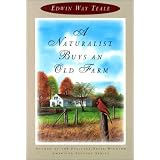
Average Reviews:

(More customer reviews)Are you looking to buy A Naturalist Buys an Old Farm? Here is the right place to find the great deals. we can offer discounts of up to 90% on A Naturalist Buys an Old Farm. Check out the link below:
>> Click Here to See Compare Prices and Get the Best Offers
A Naturalist Buys an Old Farm ReviewEdwin Way Teale won both the Pulitzer Prize and the John Burroughs Medal for distinguished nature writing. If you are interested in the natural history of our land, his 'American Seasons' series is the perfect place to start reading. All of his books, including "A Naturalist Buys an Old Farm" reflect the philosophy of Thoreau and Muir and the value they placed on the meaning and beauty of the natural world.This author belongs to the same generation of nature writers as Rachel Carson, Loren Eiseley, Sigurd Olson, and Lewis Thomas, but his writing style is less didactic, gentler, more wondering. He shares his life on an old Connecticut farm now reverting to its original wildness, with keen observation and unabashed wonder. Edwin Way Teale was the opposite of cynical. He was a man who loved to wake up in the morning, whether it was to freshly fallen snow, the "trip-hammer tattoo" of a flicker "in the full flush of his springtime exuberance," or even the fiery blisters from a run-in with poison sumac. As to the latter experience, he writes that it was shared with John Burroughs who, sixty-eight years before on the banks of the Hudson, "had viewed the world through one eye...while the other was swelled shut as a result of encountering poison sumac."
In chapter one, "Three Circles on a Map," Edwin and his wife Nellie spend three years searching for the perfect home, surrounded by various aspects of American wilderness, e.g. woods, a stream, a swamp, open meadows (not your usual home-buyer's requirements). After so many years of crisscrossing the United States and recording their travels in the four 'American Seasons' books, they were ready to sink roots and find contentment in their immediate surroundings. They finally find their dream house in a rural northeastern corner of Connecticut, and settle in to observe her wildlife and her seasons.
"There is, in the gaze of a skunk, something innocent and childlike," writes Teale, and so it is with him, too. He writes with knowledge, yet with an 'innocent gaze,' of his and Nellie's years on Trail Wood Farm. Perhaps the reason this book appeals so strongly to me is that I'm also dreaming of a place to settle lightly on the land.
Aren't we all?
Instead of the usual city-dweller's "Winter is icummen in, Lhude sing Goddamn," wouldn't it be more satisfying to spend an afternoon, like this author, watching a woodchuck prepare its burrow for hibernation, or observing two skunks wrestling over a bit of food?
Through the pages of Teale's book, we are able to live in nature, at least vicariously.
Contemporary essayist and natural historian Ann Haymond Zwinger writes a very sad introduction to "A Naturalist Buys an Old Farm." It colored my whole reading of the book, so you might want to save the introduction for last.A Naturalist Buys an Old Farm OverviewA book about a time gone by, about family, about growing up -- storytelling and descriptive nature writing at its best.The great naturalist, Edwin Way Teale, spent his boyhood holidays and summers at his grandparents' farm, Lone Oak, in Indiana. In Dune Boy, first published in 1943, he recounts these buccolic visits and his budding interest in the natural world around him. A loner, often bullied by other children, Teale escaped to the roof of the old house where he gazed at the golden dunes in the distance, and dreamed his own fantastic dreams.The young Teale was fascinated by moths, dragonflies, snakes, and the workings of the farm. He yearned to fly. He tried to hitch a calf to a cart, to ride a pig. He created a "museum" for his collections of arrowheads, stones, and fish skeletons. Most of all, he enjoyed his storytelling, hardworking grandfather, and his book-reading, equally hardworking grandmother. They reveled in and encouraged him. He returned to Lone Oak every summer until he was fifteen, when the old farm house caught fire and burned down.
Want to learn more information about A Naturalist Buys an Old Farm?
>> Click Here to See All Customer Reviews & Ratings Now

0 comments:
Post a Comment